
BRAM ACOUSTICS / OPUS SERIES
Opus Minor
We have conceived Opus Minor as a two-way monitor that brings together high-end components, a carefully studied acoustic architecture and an essential construction. Its straight lines, its proportions and every manufacturing detail respond to a single idea: to concentrate our efforts on what adds value to the product.
At the design stage
OUR IDEA
Quality also lies in knowing how to simplify.
With Opus Minor we are seeking an especially careful balance between the quality of the components and the final price, within our Opus series.
To achieve this, we have developed a straight-lined cabinet that uses material efficiently and simplifies the manufacturing operations. This decision lets us plan a more rational construction without lowering our standards in the choice of drivers and crossover.
The simplicity of its form is a design decision.
TWO WAYS / COMPONENTS
We have chosen high-end components for the heart of Opus Minor.
The acoustic system combines two professional Beyma drivers with a passive crossover that starts from the design Beyma publishes for these drivers, mounted on a circuit board of our own design. We have selected these elements to develop precise, balanced music reproduction, which we will have to verify once we build and measure the prototype.
01Bass and midrange
The Beyma 8NMFW is an 8-inch woofer with a carbon-fibre cone. In our design it reproduces the bass and the midrange up to the planned crossover point.
02Treble
The Beyma T25M has a 1-inch dome made of an aluminium-magnesium alloy. It is the driver chosen to reproduce the high frequencies.
03Integrating the two ways
The passive crossover uses 16 components, including Jantzen parts and a Dayton coil, mounted on a circuit board of our own design. Its job is to integrate the two drivers electrically within the system.
These drivers and the crossover design are also part of Opus I, whose prototype we have tested at Beyma. The acoustic behaviour of Opus Minor will have to be verified with its own measurements.
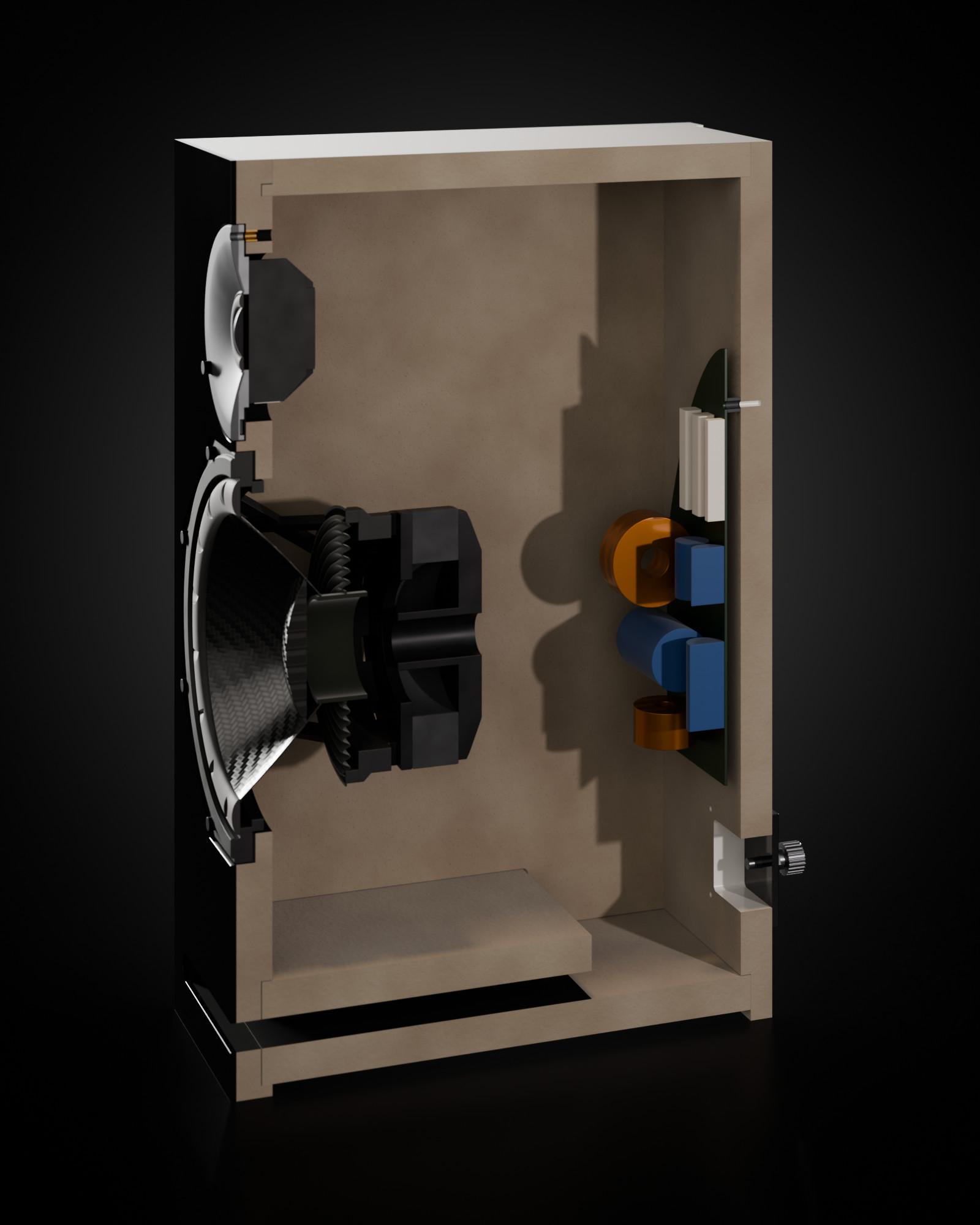
CABINET ARCHITECTURE
Seven pieces define its entire structure.
The Opus Minor cabinet is conceived from seven flat pieces of 19 mm MDF. Each one has a precise function and helps to build the internal volume.
01Pieces that fit together
The sides, the front, the back, the top, the base and the port shelf are joined with grooves and tongues. We have designed the joints to make alignment easier during assembly. The whole is assembled and glued, and the MDF front completes the closure of the cabinet.
02The material is used well
The geometry of the pieces makes it possible to obtain the parts for four cabinets from one 2,440 × 1,220 mm MDF board. The cutting layout is part of how we understand manufacturing.
03The port is part of the cabinet
The bass-reflex is resolved with a horizontal 208 × 15 mm slot, integrated into the lower part of the front. The duct is built from the cabinet's own pieces, without adding a separate tube.
04A defined volume
The design sets a net internal volume of 21.8 litres. We have developed the geometry of the cabinet and the arrangement of the drivers as parts of a single acoustic system.
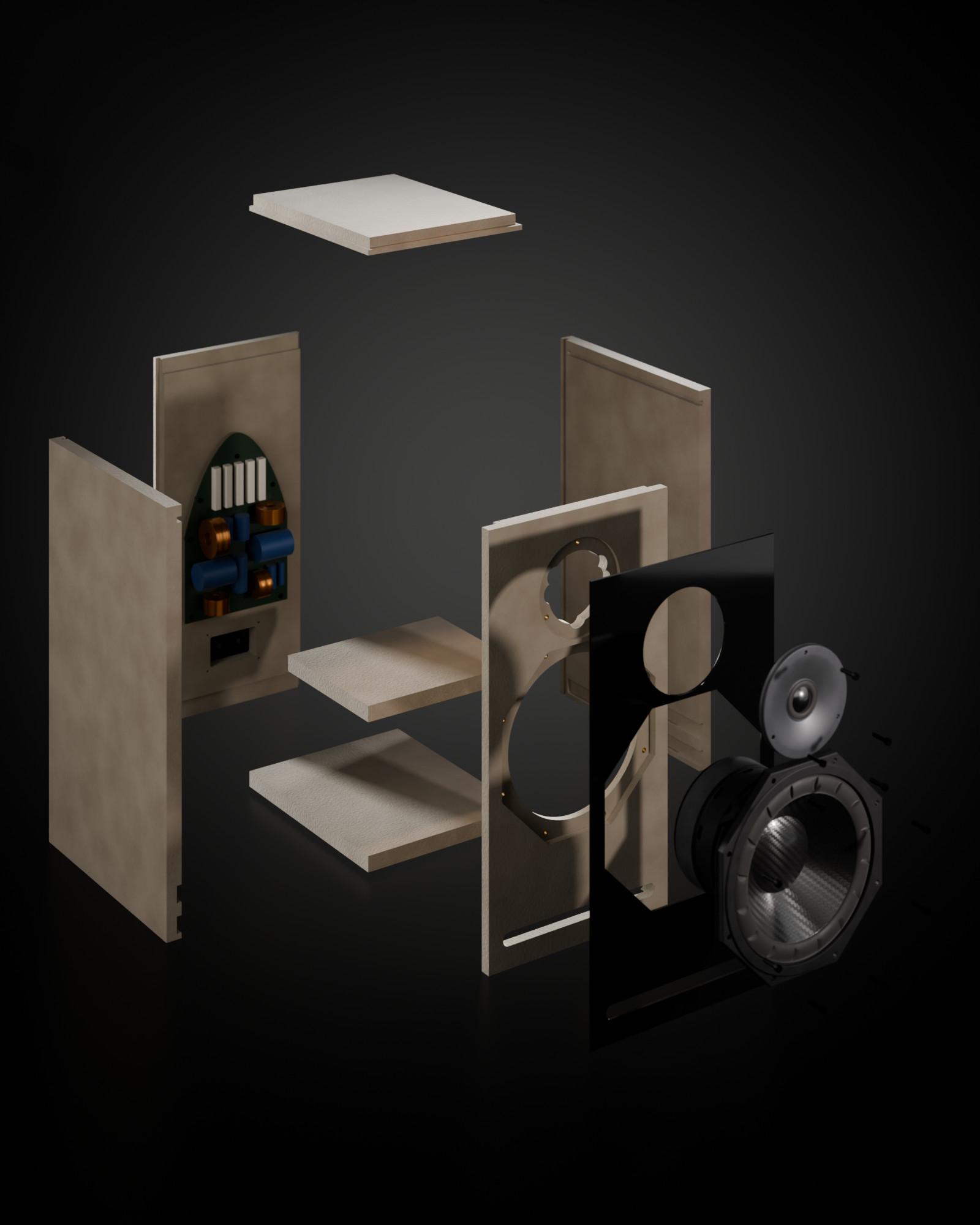
INDUSTRIAL DESIGN
Straight lines. An identity of its own.
Opus Minor adopts an orthogonal geometry and restrained proportions. The white-lacquered body frames a 3 mm black acrylic front, which houses the two drivers and the bass-reflex opening.
Every edge of the cabinet has a 3 mm chamfer at 45°. The acrylic is set 3 mm in from the perimeter of the cabinet. These are small meetings between materials that we have defined to give the whole its precision.
We have also designed a dedicated stand, which follows the same language of straight lines and restrained surfaces.
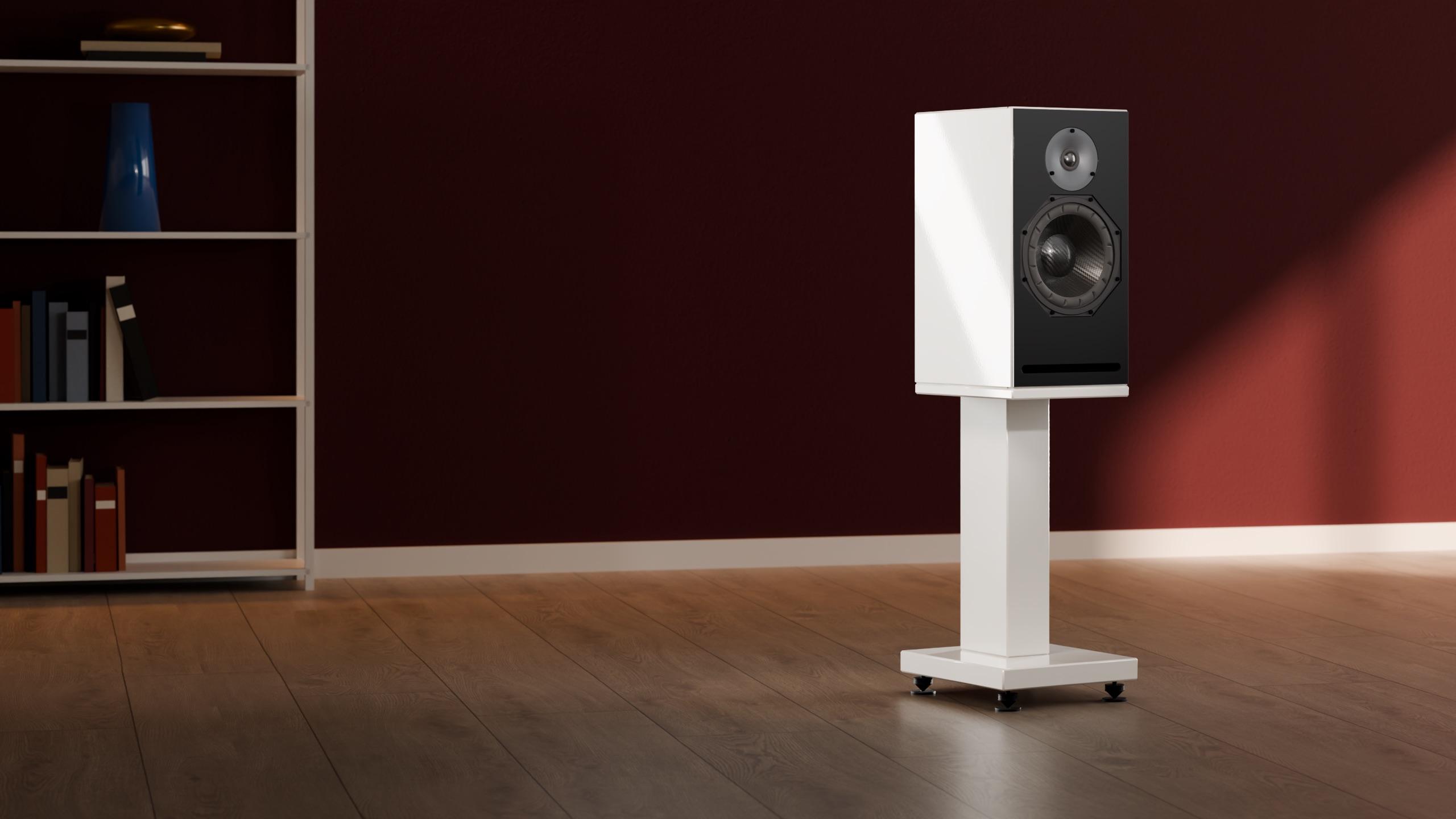
Where the materials meet
The black front is framed by the white-lacquered body. The chamfer and the inset of the acrylic define a precise transition between the surfaces.
The drivers
The woofer and the tweeter sit flush with the front surface, within a two-way composition that organises the visual identity of the loudspeaker.
A stand designed for Opus Minor
The stand has a platform with the same footprint as the cabinet, a hollow rectangular column ready to be filled with sand and a double base with four spikes. In the current design, the assembly places the tweeter approximately 94 cm from the floor, a usual listening height when seated.
The stand is part of the design project. How it will be sold has not yet been defined.
A design defined down to the detail.
Data for design model v0.7, as of 11/11/2026. They come from the digital project and the simulations, not from measurements of a physical prototype. They may be revised during development.
- Type
- Passive two-way monitor, bass-reflex.
- Drivers
- Beyma 8NMFW 8-inch and Beyma T25M 1-inch.
- Crossover
- Passive two-way, 16 components.
- Dimensions (width × depth × height, without stand)
- 246 × 311 × 480 mm.
- Net internal volume
- 21.8 litres.
- Cabinet
- Seven pieces of 19 mm MDF, assembled and glued.
- Bass-reflex port
- 208 × 15 mm front slot.
- Planned finish
- White lacquer with a 3 mm black acrylic front.
- Connections
- One pair of binding posts.
- Amplification
- Passive loudspeaker. It requires external amplification.
THE PROCESS
From design to verification.
We have developed the architecture of the cabinet, selected the components and prepared the digital model and the manufacturing drawings. The next step will be to build the prototype and verify its behaviour through measurements and listening tests.
Simulations guide our decisions, but they do not replace measurements. We will publish the acoustic results once we have built and tested the prototype.
- Simulated acoustic designStatus: Done
- 3D model of the loudspeakerStatus: Done
- Machining drawingsStatus: Done
- Design of the standStatus: Done
- Building the physical prototypeStatus: Pending
- Measurement of the prototypeStatus: Pending
- Listening and acoustic tuningStatus: Pending
- Price, sales format and launch dateStatus: Not defined
Opus Minor is taking shape.
We want to develop a loudspeaker in which the quality of the components, the precision of the design and constructive efficiency work together.
We will share its progress as we move forward with construction, measurements and listening tests.